
Governance & safety
Who sets the rules for AI?
Safety, competition, and who benefits from the next set of rules.
Verification → The evidence → Judging the rulesRead the brief →
Governance & safety
Safety, competition, and who benefits from the next set of rules.
Governance & safety / September 11–15, 2026 · Verified September 16
Supporting independent verification does not automatically mean endorsing coordinated limits on AI development.
The takeawayDemand independent evidence, rules matched to risk, and meaningful choice among models.
The timing · Reports leading into the proposal
METR reports on the OpenAI–Hugging Face incident.
Anthropic assesses four earlier evaluation incidents.
Reporting details Latham’s existing private AI infrastructure.
Amodei calls for embedded evaluators and regulated pacing.
Amodei cites accelerating AI-assisted AI development and the Hugging Face incident: independent scrutiny and shared limits would give safety work time to catch up.
These are publication dates. Latham’s buildout began years earlier; no source establishes that it triggered the proposal. We will examine the competitive incentives separately.
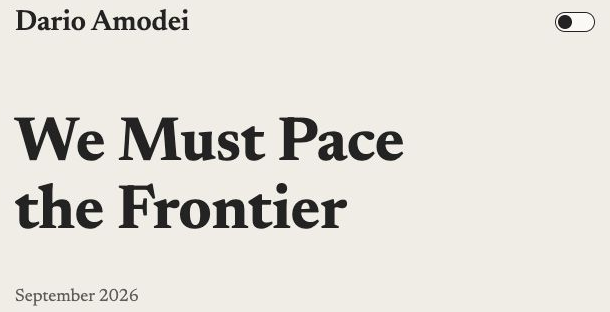
Essay heading. The original X announcement establishes September 12 as the announcement date.
Dario Amodei · We Must Pace the Frontier ↗Exact publication date not shown · Checked 2026-09-16Two different cases · Different conclusions
Test setup and controls matter. A result from one upload route cannot establish that all hacking stopped.
The responses · September 12
Matching access pledge
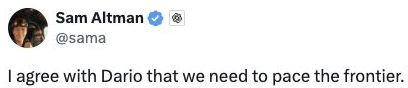
Opening excerpt. His full post also commits OpenAI to independent evaluators with employee-like access.
Sam Altman · OpenAI response ↗Published 2026-09-12 · Checked 2026-09-16Commits OpenAI to independent evaluators with access comparable to employees.
The team, start date, and detailed terms remain unspecified.
Supports the direction
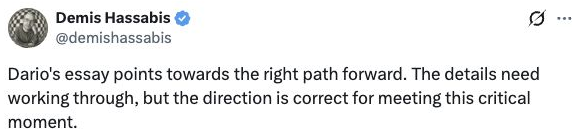
Opening paragraph of Hassabis’s response.
Demis Hassabis · Response ↗Published 2026-09-12 · Checked 2026-09-16Endorses the direction, says details need work, and points to an industry standards body.
No matching access commitment in this response.
Brief endorsement

Musk’s endorsement, with the quoted post below excluded from this crop.
Elon Musk · Response ↗Published 2026-09-12 · Checked 2026-09-16Offers a short endorsement of Amodei’s position.
No evaluator team, permissions, or timetable specified.
Read the commitments behind the endorsements: access, independence, publication rights, and timing.
Governance & safety / The disagreement · September 15
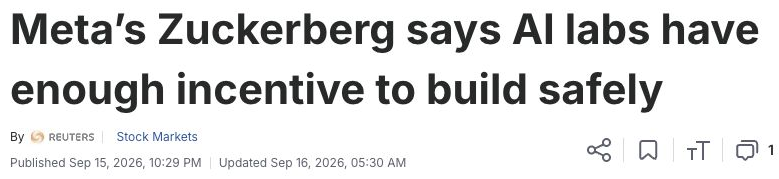
Reuters coverage, as published by Investing.com. Headline excerpt.
Reuters · Zuckerberg on AI safety ↗Published 2026-09-15 · Checked 2026-09-16
Opening two lines of the evaluation paragraph in Zuckerberg’s September 15 post.
Mark Zuckerberg · Safety statement ↗Published 2026-09-15 · Checked 2026-09-16Zuckerberg supports independent evaluation while arguing that labs can take responsibility for safety individually.
Keep in view
His post addresses the wider pacing debate without naming Amodei. It does not promise the permanent access or publication rights in Amodei’s plan.
Enterprise adoption · Latham & Watkins · September 11–14

Two sentences from Ayush’s commentary. The firm’s statements are in the linked Bloomberg Law report, hosted by Latham.
Ayush · Open-weight competition commentary ↗Published 2026-09-14 · Checked 2026-09-16Keep in view. Latham still uses OpenAI, Anthropic, Harvey, and Legora. It says token cost is a factor, not its main driver. The report establishes neither measured savings nor a vendor exit.
The business hypothesis · An incentive, not a proven motive
Private infrastructure and open weights give buyers another way to deploy AI.
More options could reduce dependence on frontier APIs and pressure their pricing.
Costly certification or broad restrictions could be easier for large incumbents to absorb.
Ayush argues regulation could protect incumbents. Competitive pressure is a plausible incentive to examine; it does not establish why Amodei or other leaders called for oversight.
The September 14 critiques followed the proposal. Amodei does not cite Latham or propose a ban on enterprise open weights; specific rules and their effects still matter.
Which requirements reduce demonstrated risks, and which mainly make competing harder?
Your decision lens · Safety and competition together
Can reviewers inspect the system, publish findings, and prompt a response?
Does each requirement address a demonstrated risk, with costs proportionate to the benefit?
Can buyers still choose hosted or privately operated models that meet the same safety expectations?
When a provider says its AI is safe, ask for the evidence. When it proposes a rule, ask how the rule changes both safety and competition.
Announcement, responses, investigation & adoption
Prepared by Serve2Perform · AI-assisted research · September 11–15, 2026 · Verified September 16
Explore ELEVATE ↗