
Value vs. Effort Matrix vs. Other Frameworks
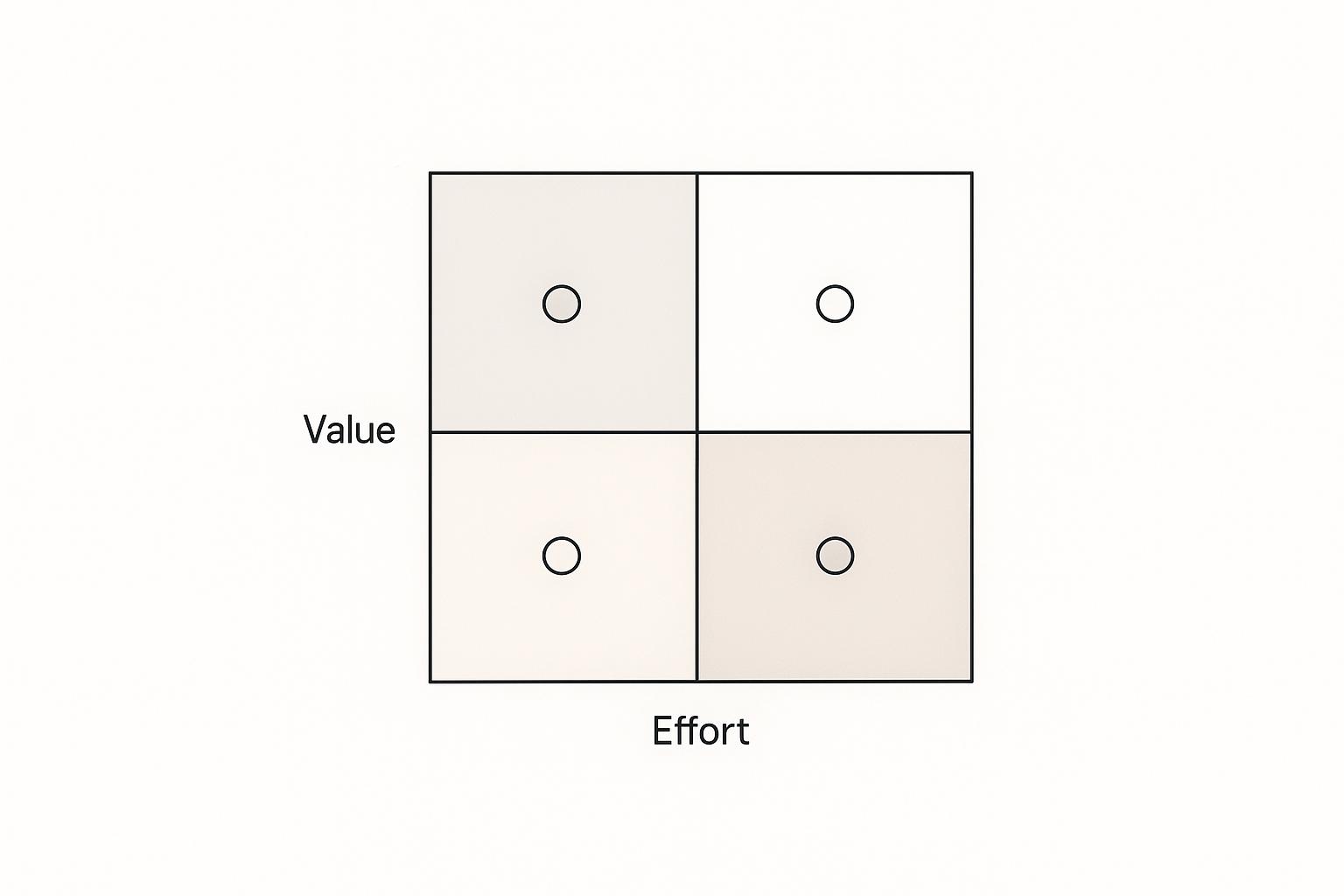
The Value vs. Effort Matrix is a simple prioritization tool that helps technical teams focus on tasks with the highest impact and least effort. It uses a 2x2 grid to categorize tasks into four quadrants: Quick Wins, Big Bets, Fill-ins, and Time Sinks. While quick to use and visually clear, it may lack depth for complex decisions.
Other frameworks like WSJF, RICE Scoring, and the Kano Model offer more detailed approaches. WSJF focuses on economic trade-offs, RICE uses data-driven scoring, and the Kano Model prioritizes customer satisfaction. Each framework has strengths and weaknesses depending on team size, available data, and project complexity.
Key Takeaways:
- Value vs. Effort Matrix: Best for fast, simple decisions with limited data.
- WSJF: Ideal for agile teams managing cost of delay.
- RICE Scoring: Great for data-driven prioritization in scaling teams.
- Kano Model: Focuses on customer satisfaction for UX-driven projects.
Quick Comparison:
| Framework | Strengths | Weaknesses | Best Use Cases |
|---|---|---|---|
| Value vs. Effort | Simple, fast, visual clarity | Subjective, limited scope | Startups, quick decisions |
| WSJF | Economic focus, agile-friendly | Complex, data-intensive | Enterprises, backlog management |
| RICE Scoring | Multi-factor, data-driven | Time-consuming, data-heavy | Product roadmaps, scaling teams |
| Kano Model | Customer-focused | Research-intensive | UX-driven, user satisfaction goals |
Choosing the right framework depends on your team's size, goals, and available resources. Start simple and evolve as your needs grow.
Top 7 Prioritization Techniques In Product Management | Prioritization Techniques | Simplilearn

Value vs. Effort Matrix: Strengths and Weaknesses
The Value vs. Effort Matrix has its advantages and limitations. Knowing both sides can help technical leaders decide when this framework is a good fit and when other tools might work better.
Strengths of the Value vs. Effort Matrix
One of its biggest advantages is its simplicity. You can set it up quickly and start making decisions without much fuss. For instance, a team can evaluate and score a dozen features in under an hour. Unlike more complex scoring systems that demand extensive data collection, this matrix gets the ball rolling fast, producing clear outcomes that everyone can understand.
Another key strength is its visual clarity. The 2x2 grid format makes it easy to spot trends and outliers. For example, if a cluster of features lands in the "quick wins" quadrant, it’s immediately clear where your team’s focus should go. This visual approach is especially helpful during meetings where stakeholders need to grasp priorities quickly.
The matrix also shines in identifying quick wins - those high-impact, low-effort tasks that can deliver immediate results. For teams under tight deadlines or with limited budgets, these quick wins can create the momentum needed to secure more resources or leadership support.
Its flexibility is another plus. Teams can define "value" and "effort" based on their specific context. A startup might prioritize user acquisition, while a larger company could focus on cost savings. Similarly, "effort" might mean development hours, infrastructure costs, or technical complexity, depending on what matters most to the team.
Finally, the collaborative nature of scoring encourages alignment. By clarifying assumptions and fostering consensus, the process helps reduce surprises or disagreements later in the project.
But like any tool, it has its downsides.
Weaknesses of the Value vs. Effort Matrix
The simplicity that makes the matrix appealing can also be its Achilles' heel, especially when dealing with complex tradeoffs. Real-world decisions often involve more than just value and effort. Factors like technical dependencies, regulatory requirements, market timing, or strategic alignment don’t fit neatly into the matrix’s two-dimensional framework.
Another challenge is subjectivity. Scoring relies heavily on team judgment, which can introduce bias and inconsistencies. What one person sees as "high value", another might consider "medium." Without solid data or benchmarks, this subjectivity can lead to disagreements or decisions that may not hold up under closer scrutiny.
The matrix also struggles with scalability. While it works well for prioritizing 10–20 items, it becomes less effective with larger lists. A grid cluttered with 50+ initiatives loses the visual clarity that makes it useful in the first place.
Additionally, the matrix offers limited depth. It provides a snapshot of priorities at a specific moment but doesn’t account for changing market conditions or evolving project requirements. It also overlooks the interconnected nature of many technical projects, where completing one task might unlock - or block - others.
Use Cases and Examples
Despite its limitations, the Value vs. Effort Matrix is highly effective in certain scenarios. For instance, it’s a great tool for MVP development, helping teams identify the minimum set of features needed to launch a product. It clearly separates must-haves (quick wins) from less critical features (time sinks or fill-ins).
It’s also useful for feature prioritization in established products. Product teams often rely on the matrix to decide which features to include in upcoming releases, especially when dealing with fixed sprint capacities or tight deadlines.
Another area where the matrix proves its worth is resource allocation. Technical leaders can use it to prioritize tasks like infrastructure upgrades, addressing technical debt, or investing in tools. By highlighting quick wins versus time sinks, it makes resource decisions more straightforward.
The matrix works best in time-sensitive scenarios requiring quick decisions or during early-stage planning, where detailed requirements or technical specs aren’t yet available.
However, for highly complex projects with many interdependencies or situations where multiple criteria beyond value and effort are critical, the matrix falls short. In such cases, more detailed frameworks like RICE scoring or weighted decision matrices may be better suited.
Other Prioritization Frameworks
The Value vs. Effort Matrix is a straightforward and visually intuitive tool, but it’s not the only game in town. Other frameworks provide different angles for prioritization, focusing on factors like economic trade-offs or insights into customer behavior. Whether it’s WSJF’s emphasis on economic metrics, the Kano Model’s customer satisfaction focus, or RICE’s data-driven scoring, these methods give technical leaders the flexibility to tackle challenges while keeping their teams aligned with broader goals.
Weighted Shortest Job First (WSJF)
WSJF uses an economic lens to prioritize tasks, weighing the cost of delay against the effort required. It calculates priority by dividing the Cost of Delay by Job Size, helping teams zero in on tasks that deliver the most value in the least time. This approach is especially handy in agile environments where sequencing work strategically is key.
For example, a fintech startup might rely on WSJF to decide which regulatory compliance features to address first, focusing on tasks with the highest cost of delay to avoid fines or reputational risks. According to Atlassian, WSJF can improve value delivery speed in agile teams by up to 30% [1]. However, the framework’s success hinges on accurate estimates of both delay costs and effort, which can sometimes be subjective or inconsistent. It works best when teams have solid data on the economic impact of delays and realistic effort assessments, making it a strong choice for juggling multiple priorities.
Kano Model
The Kano Model shifts the focus to customer satisfaction, classifying features into three main categories:
- Basic needs: Must-haves that prevent dissatisfaction.
- Performance needs: Features that proportionally boost satisfaction.
- Delighters: Unexpected features that surprise and delight customers.
This framework helps teams distinguish between features that merely satisfy and those that truly stand out. For instance, a SaaS company might survey users to identify "delighter" features - like seamless one-click integrations - and prioritize these to enhance retention rates.
While the Kano Model is particularly useful for consumer-facing products in competitive markets, it does require ongoing customer research, which can be time-consuming. That said, the insights gained are invaluable for crafting a product strategy that genuinely resonates with users.
RICE Scoring
RICE Scoring takes a numbers-first approach, evaluating initiatives based on four factors:
- Reach: How many users will be affected?
- Impact: How much will it affect each user?
- Confidence: How certain are the estimates?
- Effort: How much work is required?
The formula - (Reach × Impact × Confidence) ÷ Effort - produces a score that makes it easier to compare and rank initiatives.
This method appeals to data-driven teams thanks to its transparent and repeatable process. For instance, an e-commerce platform might use RICE to prioritize marketing features aimed at maximizing reach and impact during the holiday season. Intercom reported a 20% improvement in roadmap alignment and stakeholder satisfaction after adopting RICE Scoring in 2022 [1]. However, the framework relies heavily on reliable data for each factor. Without accurate metrics, teams may spend more time debating scores than making decisions.
RICE works best for product roadmaps where robust data is available, making it easier to prioritize features. It’s less effective for early-stage or highly experimental projects where historical data is scarce. Together, these frameworks provide technical leaders with a diverse toolkit to navigate various prioritization challenges effectively.
sbb-itb-8feac72
Framework Comparison: Value vs. Effort Matrix vs. Others
Building on the strengths and limitations outlined earlier, let's dive into how different prioritization frameworks stack up against each other.
Comparison Criteria
When deciding on a prioritization framework, technical leaders have to weigh several factors that directly influence their team's efficiency and decision-making pace. For teams juggling tight deadlines and limited resources, simplicity often takes center stage.
The Value vs. Effort Matrix relies on just two factors - value and effort - making it ideal for teams with limited data. On the other hand, WSJF (Weighted Shortest Job First) demands detailed estimates for cost of delay and job size, while RICE scoring requires four distinct metrics: reach, impact, confidence, and effort. Meanwhile, the Kano Model stands apart, focusing on customer research and qualitative feature categorization.
The data needs of these frameworks also vary widely. Teams without access to robust analytics may struggle with data-heavy frameworks like RICE and WSJF. In contrast, the Value vs. Effort Matrix thrives on basic estimates and subjective inputs, making it more approachable for teams with limited historical data or measurement systems.
Another key consideration is the balance between objectivity and speed. Frameworks like RICE offer a structured and objective scoring system but can slow down decision-making. This trade-off can lead to analysis paralysis if not managed carefully.
Best-Fit Scenarios
The Value vs. Effort Matrix shines in startup environments or small teams where agility and resource optimization are non-negotiable. For technical leaders who need to make fast decisions with minimal data, this framework provides a straightforward, visual tool that promotes team alignment without bogging things down in analysis.
In contrast, enterprise teams often benefit from frameworks like WSJF or RICE. These organizations typically have the resources and time to gather detailed metrics, making the complexity of these frameworks worthwhile. They are particularly effective for managing large backlogs or coordinating across different departments.
For projects with high uncertainty - such as exploring new markets or experimenting with unproven technologies - the Value vs. Effort Matrix is a better fit. Its flexibility allows teams to pivot quickly as new information becomes available.
The Kano Model is best suited for customer-focused organizations where user satisfaction drives strategy. SaaS companies aiming to boost retention or consumer products competing on user experience often gravitate toward this approach, despite its time-intensive research requirements.
Here's a quick reference table that summarizes these comparisons:
Framework Comparison Table
| Framework | Strengths | Weaknesses | Requirements | Ideal Use Cases |
|---|---|---|---|---|
| Value vs. Effort Matrix | Simple, visual, promotes quick alignment | Subjective scoring, limited factor scope | Basic estimates, team agreement on definitions | Startups, resource-limited teams, fast decisions |
| WSJF | Data-driven, aligns with economic priorities | Complex calculations, needs detailed metrics | Cost of delay data, job size estimates | Agile teams, backlog management, enterprises |
| Kano Model | Customer-focused, highlights satisfaction drivers | Time-consuming, relies on qualitative research | Customer surveys, feedback mechanisms | UX-driven products, user satisfaction goals |
| RICE Scoring | Balanced, multi-factor analysis | Data-heavy, risk of over-analysis | Metrics for reach, impact, confidence, effort | Product roadmaps, scaling teams, feature ranking |
Matching Frameworks to Context
No single framework is universally superior. Many technical leaders start with the Value vs. Effort Matrix for its simplicity and ease of use, especially when their teams are new or lack extensive data. As organizations grow and mature, they often transition to more complex frameworks like WSJF or RICE, reflecting a shift from solving immediate technical problems to developing long-term strategies.
Ultimately, the best choice depends on aligning the framework's complexity with the organization's readiness and the specific decision-making context, rather than defaulting to the most intricate option available.
Choosing the Right Framework for Technical Leaders
Factors to Consider in Framework Selection
When selecting a framework, several factors come into play: team size, product stage, available resources, and leadership goals. For smaller teams, the Value vs. Effort Matrix works well because it encourages open discussions and quick consensus. On the other hand, larger teams often prefer structured methods like RICE scoring, which help avoid endless debates and provide an objective way to prioritize.
Early-stage startups often lean on the Value vs. Effort Matrix for its simplicity and agility. It enables them to pivot quickly as they experiment and learn what resonates with their users. As the product matures and stakeholder priorities multiply, frameworks like RICE or WSJF become more suitable, offering a structured way to manage competing demands. In cases where customer insights play a critical role, the Kano Model can add depth by focusing on user satisfaction.
In environments with limited resources, teams need methods that deliver results without requiring extensive analysis. The Value vs. Effort Matrix shines here, relying on quick estimates and collaborative discussions. In contrast, frameworks like WSJF, which require detailed cost-of-delay calculations, may not be practical in such settings.
Leadership goals also influence framework choice. Leaders focused on speedy feature delivery might opt for simpler models that avoid over-analysis. Conversely, those aiming for long-term alignment with business goals may prefer more detailed frameworks that offer deeper insights into customer needs and overall value.
Interestingly, surveys reveal that over 60% of product teams use prioritization matrices, and structured frameworks have been shown to improve project delivery rates by 25% [1].
Ultimately, the success of any framework relies heavily on effective leadership.
Leadership Development and Framework Adoption
Choosing a framework is just the first step; how leaders implement and champion it determines its impact. For technical leaders, bridging the gap between technical expertise and business outcomes is key. This requires developing skills like strategic thinking, stakeholder management, and clear communication.
While technical knowledge is vital, it’s not enough when making decisions that influence product roadmaps and team priorities. Leadership training becomes crucial for adopting frameworks successfully. Leaders must learn to guide discussions, explain the reasoning behind their chosen framework, and adapt it to meet their team’s specific needs. Strong communication skills are also essential for explaining prioritization decisions to stakeholders who may not fully grasp the technical nuances.
Organizations like Tech Leaders offer programs tailored to help technical professionals build these non-technical skills. Their training focuses on bridging the divide between technical know-how and business strategy, which is essential for using prioritization frameworks effectively.
"Our programs bridge the gap between technical expertise and business outcomes."
- Tech Leaders
These leadership programs help technical professionals transition from purely technical roles to strategic decision-makers. They cover areas like executive presence, career advancement strategies, and mental resilience - skills that are critical for driving change and maintaining momentum when introducing new frameworks.
Practical implementation often starts with pilot programs, where leaders test a framework, gather team feedback, and refine their approach. Leaders who invest in developing broader business skills are better equipped to handle the dynamics that can make or break the adoption of new frameworks.
Additionally, many leaders are finding value in combining simple frameworks with more advanced ones as their teams grow. Those with strong business acumen can recognize when it’s time to evolve from basic methods to more complex approaches, ensuring the transition is smooth and maintains both productivity and morale.
Key Takeaways
The Value vs. Effort Matrix is a go-to tool for technical leaders when speed and simplicity are key. Its straightforward 2x2 layout makes it easy for teams to identify quick wins and weed out tasks that don’t add much value - without needing extensive training or complicated calculations. In fact, research shows that using structured frameworks like this can improve productivity by over 25% [2].
That said, its simplicity does come with a few drawbacks. Because the framework relies on subjective estimates, team members may have differing opinions on what constitutes "value" or "effort", which can result in inconsistent outcomes if there's no standardization. Plus, focusing solely on these two dimensions means other factors - like risks, dependencies, or long-term strategy - might get overlooked.
Different frameworks suit different needs. For example:
- WSJF (Weighted Shortest Job First) works well in situations where time-to-market is critical, as it factors in the cost of delay.
- The Kano Model prioritizes features that enhance customer satisfaction, helping teams focus on what truly delights users.
- RICE Scoring provides a more data-driven approach, but it requires a deeper level of analysis and more detailed inputs.
The key to success is choosing the right framework for your context. Smaller teams or early-stage startups often thrive with the Value vs. Effort Matrix due to its flexibility and ease of use. On the other hand, larger organizations with more complex needs may find frameworks like RICE or WSJF better suited to their goals. For teams focused on user experience, the Kano Model provides a customer-first lens that can guide feature prioritization. Matching the framework to your unique situation sets the stage for more effective execution.
Once you've selected a framework, execution becomes the priority. Start by clearly defining what "value" and "effort" mean for your team. Involve cross-functional members to minimize bias, and revisit your prioritization regularly as new information comes to light. The most successful leaders know when to combine simple and advanced frameworks as their team's needs evolve.
FAQs
How can a team choose the right prioritization framework for their project?
To choose the most suitable prioritization framework for your project, begin by clearly defining your goals, constraints, and key priorities. For instance, the Value vs. Effort Matrix works well when you need to weigh potential impact against the resources required. However, depending on the complexity of your project or the needs of stakeholders, other frameworks might be a better fit.
Take into account elements like the size of your team, the scope of the project, and how quickly decisions need to be made. The best framework will align with your objectives and make your workflow more organized and efficient.
How can I reduce bias and subjectivity when using the Value vs. Effort Matrix?
To keep bias and subjectivity in check when working with the Value vs. Effort Matrix, start by setting clear, measurable criteria for what "value" and "effort" mean in your context. This creates a consistent framework for evaluating tasks or projects.
It's also a smart move to include a variety of stakeholders in the process. By gathering input from different perspectives, you can balance out personal biases and gain a fuller picture. Whenever you can, lean on data to guide your decisions - whether that's performance metrics, customer feedback, or other relevant insights. This approach grounds your evaluations in facts rather than opinions.
How can teams move from the Value vs. Effort Matrix to more advanced frameworks like RICE or WSJF as their projects become more complex?
Transitioning from the Value vs. Effort Matrix to frameworks like RICE (Reach, Impact, Confidence, Effort) or WSJF (Weighted Shortest Job First) can help teams make smarter prioritization decisions as projects grow more complex. The trick is understanding what each framework brings to the table and how it fits into your team’s workflow.
Start by introducing the new framework gradually, alongside your existing process. If you're experimenting with RICE, focus on breaking down tasks by measurable factors like reach and impact. On the other hand, if you're exploring WSJF, make sure your team gets comfortable calculating the cost of delay and job size. These methods may feel a bit technical at first, but they offer a clearer, data-driven way to prioritize - especially for larger, more intricate projects.
This isn’t a race. Take it step by step. Start with smaller initiatives to get a feel for the process, and as your team builds confidence, expand its use to tackle bigger challenges.